
Argentina lost world cup final 2026
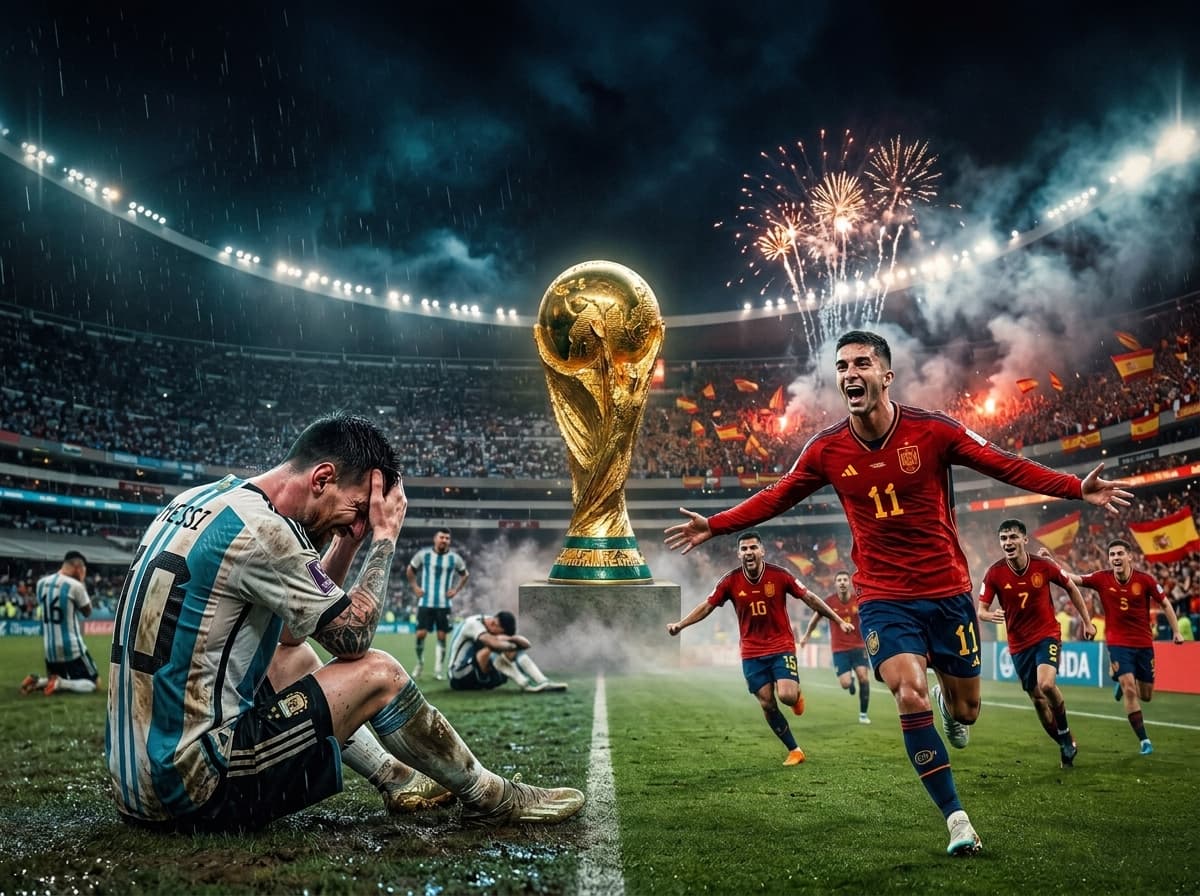
Why Didn't Argentina Become Champions? A Complete Tactical Breakdown OnlyFootballFan The 117th minute. Messi swings at a volley, and for the first time all nigh
Why Didn't Argentina Become Champions? A Complete Tactical Breakdown
OnlyFootballFan
The 117th minute. Messi swings at a volley, and for the first time all night the Spain goalkeeper has something to do.
It was Argentina's first shot of the entire final. It arrived twenty-seven minutes after regulation had ended.
A team built around the best playmaker the game has produced went ninety minutes of a World Cup final without asking the opposition goalkeeper a single question. That is the whole story. It's also the mystery worth unpicking.
So why didn't Argentina become champions? Because Lionel Scaloni built a shape designed to shield a 39-year-old Messi when Argentina didn't have the ball, and that shape handed Spain the ball, the pitch and the tempo. Argentina defended stubbornly for long stretches. They simply had no way out. Spain won 1-0 through Ferran Torres in the 106th minute, and if anything the scoreline is kind to Argentina.
They didn't lose the final so much as survive it until they couldn't.
In this breakdown
● The numbers that explain the night
● How Spain's 4-2-3-1 took the game away
● Why Argentina couldn't muster a shot
● How Spain silenced Messi
● The goal, the red card, and Martinez's record
● Was Scaloni's plan a mistake, and what comes next
Why did Argentina lose the 2026 World Cup final?
Argentina lost because their defensive structure had no attacking outlet attached to it. Scaloni set up narrow to deny Spain the middle of the pitch, which worked for ninety minutes and then gave way in extra time. Spain finished with 12 shots on target. Argentina managed nothing at all until the 117th minute.
The numbers are almost hard to believe. Here is the final in six lines.
| Spain | Argentina |
Goals | 1 (Torres, 106') | 0 |
Shots on target | 12 | 0 |
First attempt | First half | 117th minute |
Goalkeeper saves | Barely tested | 11 (Emiliano Martinez) |
Red cards | 0 | 1 (Enzo Fernandez) |
Goals conceded, whole tournament | 1 in 8 matches | n/a |
Argentina became the first team in World Cup history to play ninety minutes of a final without a shot, according to Opta. The first half produced three attempts in total, all of them Spanish, the fewest in a final since records began in 1966.
How did Spain's 4-2-3-1 take control of the game?
Spain lined up in a 4-2-3-1 and built a line of three attacking midfielders in the gap between Argentina's defence and midfield. From there they created central overloads that two banks of four could never quite cover. Coaches' Voice broke down the mechanism: Mikel Oyarzabal dropped deep to link play while Fabian Ruiz pushed forward, Marc Cucurella advanced to give width on the left, and Alex Baena rotated inside to threaten the space behind.
The effect was suffocating without ever looking frantic. Pau Cubarsi completed 121 passes and Rodri 101, two of only three occasions on record that a player has passed a hundred times in a World Cup final.
Spain never rushed. They passed Argentina into a corner and waited.
Why did Argentina go 90 minutes without a shot?
Argentina's 4-4-2 was disciplined and, for long spells, genuinely good. The centre-backs timed their releases to step onto Spain's spare man, restricting the clean combinations that had carried Spain through the tournament. For an hour it looked like a plan working.
The problem showed up the moment Argentina won the ball back.
There was nobody upfield to give it to. Messi wasn't pressing, the wide players were pinned into their own half, and Julian Alvarez was left chasing hopeful clearances alone. Every turnover ended the same way: a long ball, a Spain header, and the siege restarting.
Defending is only half a plan.
How did Spain neutralise Lionel Messi?
They barely had to. Messi touched the ball 54 times and never found a moment worth the name, as ESPN noted afterwards. Spain kept the middle of the pitch crowded, so on the rare occasions the ball reached him he was facing his own goal with two bodies attached.
Here is the cruel part. The shape Scaloni built to protect Messi is the same shape that stranded him. Sitting deep meant Argentina's best player received possession seventy yards from Spain's goal, with no runner ahead of him and no time to turn.
You cannot hide a player and rely on him at the same time.
How did the winning goal actually happen?
The 106th minute. Pedro Porro crossed from the half-space, Nico Williams timed a run to the back post, and Torres arrived ahead of Argentina's midfield to meet the knockdown. Coaches' Voice pinpointed the flaw: Argentina had shifted to a 5-3-1 in extra time, and that midfield line simply didn't have the cover to track a late runner.
Torres is only the second substitute to score a World Cup final winner. The first was Mario Gotze in 2014, who also did it against Argentina.
Why was Enzo Fernandez sent off, and did it change anything?
Enzo picked up a second yellow for a foul on Pau Cubarsi in second-half stoppage time, the sixth red card in World Cup final history. Argentina had spent much of the evening trying to rough Spain up, as Football365 reported, and Enzo was the one who paid.
Did it decide the match? Honestly, no. Argentina hadn't managed a shot with eleven men on the pitch either. The red card removed a body, not a threat.
Did Emiliano Martinez deserve better?
Martinez made 11 saves, the most by any goalkeeper on record in a World Cup final. He held a losing position together for 106 minutes against a side that had conceded one goal in eight matches.
The best individual performance in the 2026 final came from the losing team. That tells you almost everything about how the night went.
Was Scaloni's setup a mistake?
This is where it gets uncomfortable, because the plan wasn't stupid. It was a rational bet. Messi at 39 cannot press for ninety minutes, so Scaloni built density around him, forced Spain wide, and backed his defenders to hold. Against the best passing side in the world, that is a defensible choice.
The flaw is what it asks of you. A plan with no attacking phase demands perfection for 120 minutes, and nobody is perfect for 120 minutes. Spain only needed one lapse. They got it in the 106th.
Scaloni didn't dress it up afterwards. "They were better, that's the truth," he said, tearful and unsure about his own future.
There was an ugly coda too. Football365 reported that Nahuel Molina appeared to swing at Rodri during Spain's celebrations, and that Argentina's players turned their backs during the trophy lift. A great side deserved a better exit than that.
What happens now for Messi and Argentina?
Argentina are World Cup runners-up for the fourth time, after 1930, 1990 and 2014. Scaloni's future is genuinely open. And at 39, this was almost certainly the last act of Messi's World Cup story, which is a strange thing to write about a player who spent a month being marked out of a tournament rather than winning one.
Spain, meanwhile, finished with a 38-match unbeaten run, the longest by any European or South American team, one goal conceded across eight games, and a second star on the shirt.
Argentina's first attempt of the night came in the 117th minute. By then Spain had been answering questions all evening. Argentina had simply stopped asking them.
Your call. Was Scaloni's setup brave or too cautious? Vote in our fan poll and follow our World Cup 2026 coverage for the full tournament post-mortem.
FAQ
Why did Argentina lose the 2026 World Cup final?
Argentina lost 1-0 to Spain because their narrow defensive setup, built to protect a 39-year-old Messi, left them with no attacking outlet. They went the full 90 minutes without a shot and conceded to Ferran Torres in the 106th minute.
Did Argentina really have zero shots in the final?
Yes. Argentina became the first team in World Cup history to play 90 minutes of a final without an attempt. Their first shot came from Messi in the 117th minute, deep into extra time.
Who scored the winning goal in the 2026 World Cup final?
Ferran Torres, in the 106th minute. He came off the bench and met a knockdown after a Porro cross and a Nico Williams run to the back post. He is only the second substitute to score a World Cup final winner.
How many saves did Emiliano Martinez make?
Eleven, the most by any goalkeeper on record in a World Cup final. It was the standout individual performance of the match, and it came in a losing cause.
What formation did Spain use in the final?
A 4-2-3-1. Oyarzabal dropped deep to link play, Fabian Ruiz pushed forward to create central overloads, Cucurella provided width on the left, and Baena rotated inside to attack the space behind Argentina's line.
How did Spain stop Messi?
By keeping the centre of the pitch crowded and never letting Argentina build. Messi touched the ball 54 times and mostly received it facing his own goal, seventy yards from danger, with defenders already on him.
Why was Enzo Fernandez sent off?
He received a second yellow card for a foul on Pau Cubarsi in second-half stoppage time. It was the sixth red card in World Cup final history, though Argentina had not managed a shot even with eleven men.
What did Scaloni say after the final?
He admitted plainly that Spain deserved it, saying they were the better side. He was visibly emotional afterwards and left questions about his own future unanswered.
How many times have Argentina been World Cup runners-up?
Four times: 1930, 1990, 2014 and now 2026. They remain three-time winners, in 1978, 1986 and 2022.
How good was Spain's tournament?
Historically good. They conceded one goal across eight matches and arrived at the final on a 38-match unbeaten run, the longest by any European or South American side.
Was this Messi's last World Cup?
Almost certainly. Messi turned 39 before the tournament, and 2030 would put him past 42. Nothing has been formally announced, but the final looked like a farewell.
Related reading
● The night World Cup 2026 came alive: the tactical switch that changed a game
● Knockout preview: the ties that defined 2026
Keep reading
 Features
The Unbeaten Champions
The Unbeaten Champions: Spain's Historic 2026 World Cup Triumph Spain's World Cup began with a goalless draw against Cabo Verde, a country playing the first Wor
 Features
Spain Shut Down France
How Spain Shut Down France to Book Their 2026 World Cup Final Ticket TL;DR: Spain beat France 2-0 in Dallas to reach the 2026 World Cup final, and they d
 Features
New FIFA Rule Changes for the 2026 World Cup
TL;DR: Spain beat France 2-0 in Dallas to reach the 2026 World Cup final, and they did it with a defensive masterclass rather than fireworks. A midfield diamond